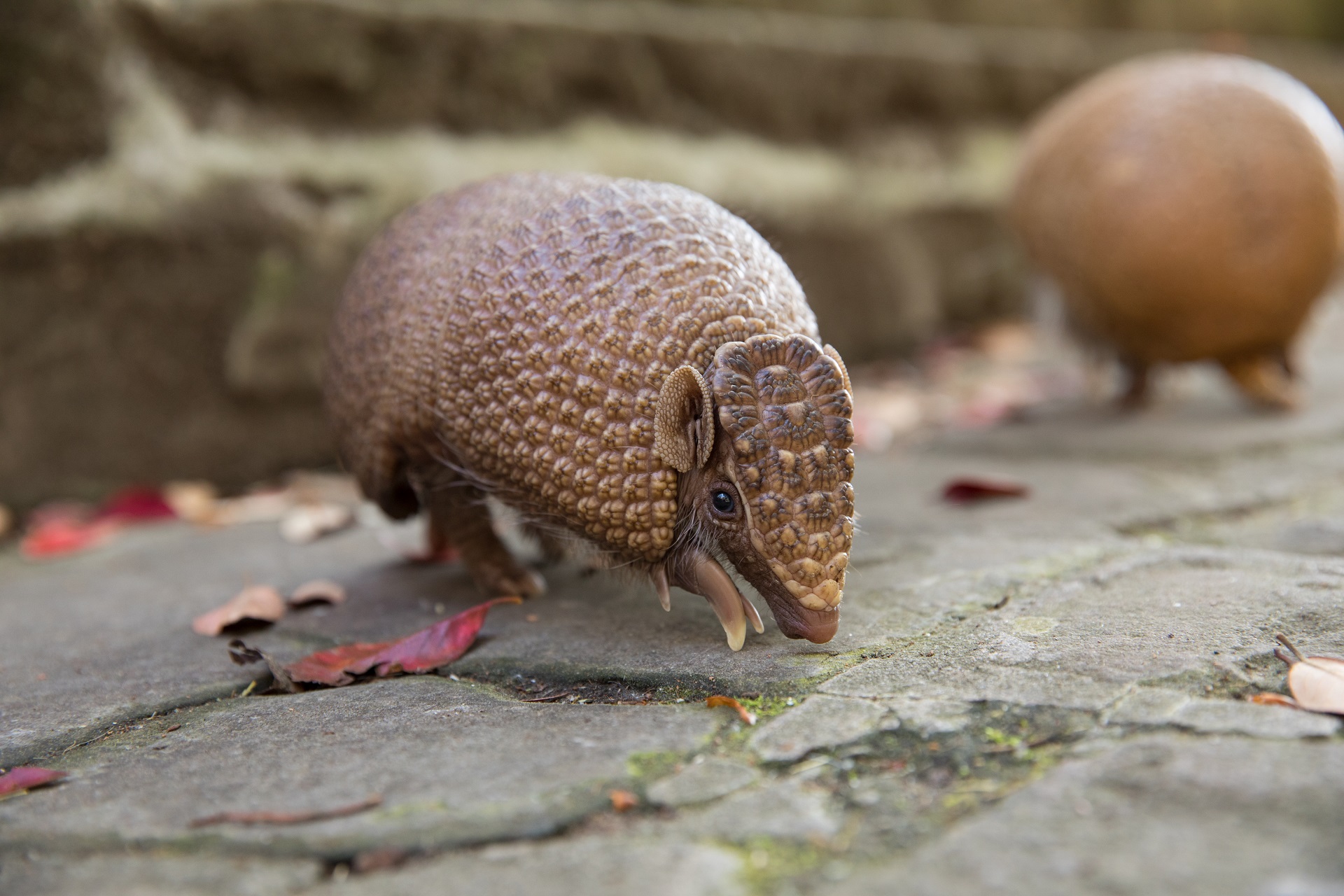
Southern three-banded armadillo
Tolypeutes matacus
There are five Southern three-banded armadillos here at Edinburgh Zoo – Rodar, Rio, Danilo, Inti and Pacha.
Rodar and Rio were both born in Poland in 2013 and arrived in Edinburgh in 2014. Danilo was born in 2016 and arrived in 2017. Both Inti and Pacha were born here at Edinburgh Zoo.
The Southern three-banded armadillo is unique for being the only armadillo that can roll into a perfect ball. This is thanks to three flexible bands in its armour, protecting its soft underside. It does this for defence against predators.
Their favourite foods are ants, termites and beetle larvae. They catch these using their long, sticky tongue.
They live in the dry forests and grasslands of Argentina, Bolivia, Brazil and Paraguay.
Population

Decreasing
Diet

Insectivore
Habitat

Grasslands
Fact file
The Southern three-banded armadillo is the only armadillo species able to roll into a ball
They do not dig burrows. Instead that take refuge in the abandoned burrows of other animals, such as anteaters
They walk on their hind-legs with the tips of their foreclaws touching the ground
They have a varied diet made up of beetle larvae, ants, termites and fruits
Latest Southern-three banded armadillo news
View all news
13 Feb 2026
One minute read
/icas.jpg)
How we're helping
As a wildlife conservation charity, we care for the animals here at the zoo and work to protect species at risk around the world. From providing expertise in genetics and veterinary health, to protecting wild places with local conservation partners, and even restoring threatened species to the wild, we are active where we are needed most.
There are around 20 species of armadillo, many of which are vulnerable. Little was known about the giant armadillo until Dr Arnaud Desbiez began his pioneering research into the species in 2011. We support the Giant Armadillo Conservation Project, the first long term ecological study of giant armadillos in the Pantanal wetland.
Find out more about the Giant Armadillo Conservation Project